
Showing posts with label proto-punk. Show all posts

Wednesday, July 29, 2009

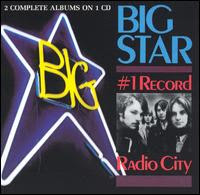
Dust It Off: Big Star - #1 Record/Radio City

#1 Record/Radio City
Album: #1 Record/Radio City
Fantasy, 1992
Recording Date: 1972-1973

Mention Big Star in a room of musicians and most will probably know exactly who you're talking about - and could even name the band members and more than a few songs. But outside of the world of indie rock and rock criticism, you'll get blank stares far more often than not. And it's not that Big Star's music requires a great spirit of adventure or high level of technical understanding to appreciate - in fact, it's some of the most straightforward pop of its era.

No, Big Star were one of many victims of bad luck and poor marketing, and their albums simply never sold. But those who were in the habit of seeking out under-the-radar music found the album and it changed the course of rock history. A list of bands that include Big Star as a key influence would be too long to attempt, but it would certainly include the likes of R.E.M., Wilco, the Cars, the Smashing Pumpkins, Teenage Fanclub, Cheap Trick -- well, you get the idea.

As one of the first "power pop" bands, Big Star drew songwriting influences from the Beatles, the Byrds and the Beach Boys, but carried out these ideas with a mindset taken directly from arena rock - though Big Star may never have filled an arena, they played as though they were born in one. Even the most subdued, acoustic numbers sound like they were not only meant for the big stage but actually create the illusion of a big stage wherever they're played.

The band's first two albums, #1 Record (1972) and Radio City (1974), were combined into a single release by Stax in 1978, but the version most commonly found is the joint release first issued in 1992 by Fantasy Records. In any case, this double LP offers well over an hour of consistently excellent songs, ranging from the wistful "Ballad of el Goodo" and the simple, finger-picked folk of "Thirteen" to the guitar-rock arena-screamer "Don't Lie to Me" and the pure radio pop of "September Gurls."

Listening to Big Star, it's obvious how they became such an icon in the history of indie rock. Though their melodies were as good (no, better) than any charting band of their time, they also displayed an edgy, noisy experimentalism. "The India Song" has an arrangement that's just plain bizarre, while the unpolished aggression of "O My Soul" is far grittier than most 1974 rock. Warm ringing guitars and sweet tunes are impossible to separate from the album's dark side. The band sounds out of their time, not ahead of it, but they predict indie and alternative rock - a world where the 1960's models of radio pop, large-scale rock and arty psychedelia were reconfigured to accommodate a more versatile, more honest weapon.

It's hard to imagine what indie rock would look like if it hadn't had Big Star as a root. The good news is, we don't have to.

Thursday, May 28, 2009

Dust It Off: Rocket from the Tombs - The Day the Earth Met the Rocket from the Tombs

OK, OK, I'm still running way behind. Dust It Off is one day late this week. My sincerest apologies...

The Day the Earth Met the Rocket from the Tombs
Album: The Day the Earth Met the Rocket from the Tombs
Smog Veil, 2002
Recording date: 1975

During the years leading up to the first wave of American punk, Cleveland, Ohio emerged as an unlikely epicenter of the new movement, drawing influence from and in turn influencing scenes Detroit and New York City. The two most notable Cleveland proto-punk bands, Pere Ubu and Dead Boys, were both born of the splintering of their joint prototype, the short-lived and oft-forgotten Rocket from the Tombs.

Feautring future Dead Boys Stiv Bators and Gene O'Connor (aka Cheetah Chrome) alongside Ubu founders Peter Laughner and David Thomas - not to mention Craig Bell of Mirrors/Styrenes - this reverse-supergroup provided the ideal petri dish in which to breed a completely original approach to rock'n'roll. Training so many of punk and post-punk's greatest innovators, RFTT could not have been more important.

However, the inevitable clashing of the group's creative minds tore them apart before any official recordings could be made - RFTT was doomed to obscurity, just a footnote in the history of punk. A handful of live recordings and demos floated around among collectors, but absolutely nothing was available commercially until the release of this compilation in 2002.*

Scraped together from what few recordings remained intact, The Day the Earth features early incarnations of many of the best Ubu and Dead Boys songs: "30 Seconds Over Tokyo," "Life Stinks" and "Final Solution" (Ubu), and "Ain't It Fun," "Down in Flames" and "Sonic Reducer" (Dead Boys).

Most importantly, however, the album includes a fairly extensive overview of Peter Laughner's work. Though Laughner would go on to found Pere Ubu, drug and alcohol problems led to his quick departure from the group and not long after, to his death at age 23. One of the greatest innovators in the Cleveland scene, Laughner's songs are profoundly affecting and remain the album's best tracks. In "Ain't It Fun" (written jointly with O'Connor), Laughner speaks of utter desperation and hopelessness, plunging as deeply into life's darkness as any lyricist to date. Such is the despondent resignation of the song that Laughner's prediction of his own early death sounds more tragic than haunting.

The rough, raw sounds of the album bring to mind garage rock and the likes of the Stooges, but the artistic approach to sound and song sets RFTT far apart from any band of their era. The ear-splitting guitars on "Final Solution" sound more like a metallic demolition you might hear in one of Cleveland's factories than like rock music. Thomas's refusal to conform to any existing notions of song craft, as evidenced by "30 Seconds Over Tokyo," would not be matched by New York's art rockers for years to come.

Many years ahead of its time, The Day the Earth is an essential document in the development of American punk. And education aside, it just fucking rocks.


*One compilation was released in the 90's but the limited pressing (<1,000) was virtually impossible to find.

Tuesday, November 4, 2008

Five Forgotten Pioneers: Part 2

OK, here's part two! (Part one is here.)

R. Stevie Moore

R. Stevie Moore has been making independent underground pop since the 1960's. Recording and releasing most of his music himself, Moore established a DIY aesthetic that would eventually be the hallmark of lo-fi, the dominant movement of American indie pop. Moore's music itself isn't lo-fi, but in his recordings, you can hear the beginnings of the intentionally messy and proudly raw sounds later adopted by the likes of Sebadoh and Pavement. Even the use of basic multitrack recording equipment like Moore's has become a badge of honor among American indie bands from Guided by Voices to the White Stripes.

Moore's releases number in the hundreds if not thousands, so of course, there's a lot of dud songs in there, but the average quality is surprisingly high. The variety among the releases is itself amazing, with genre-crossing composition at times akin to Beck's. Experimental but accessible, his pop music has always been forward-looking, innovative and fun.

NEWS: R. Stevie Moore is playing November 11, 2008 at Cake Shop in NYC. See you there!


Mirrors (a.k.a. the Styrenes)

Of the many groups immediately preceding the punk movement, few have been more forgotten than Mirrors. Part of the Cleveland scene that hatched the Electric Eels, Rocket from the Tombs and Pere Ubu, Mirrors formed in 1973, recorded a small amount of material (the majority of which went unreleased until 2001), then changed names and directions and continued into the 1980's at the Styrenes.

Mirrors play a raw, aggressive proto-punk like the Stooges or the Electric Eels, but with more thoughtful experimentalism than these bands, borrowing from early Pink Floyd as well as the Velvet Underground-inspired Cleveland and Detroit scenes. The intellectual approach of Mirrors to the subversively raw proto-punk of their peers in many ways predicts the post-punk movement, which would add the very same slowed-down thoughtfulness to its punk roots. Intelligent and creative, Mirrors included touches of prog rock and noise in their music, but they never once forgot to rock out.

Friday, October 31, 2008

Five Creepy Songs for Halloween

5. Bela Lugosi's Dead (Bauhaus) - Duh.

4. I Love You But You're Dead (Destroy All Monsters) - This song is about the confusion you feel when you love a person, but they have died and are just a corpse. And how that's kind of a problem in your relationship. Key lyric: "I love you, but you're dead / You make my bed all red!"

3. TIE: Mildred Pierce v. Pacific Coast Highway (Sonic Youth) - Hard to pick the creepier of these Sonic Youth tunes. Mildred Pierce involves a tense, repetitive guitar line followed by shrieking. Pacific Coast Highway features really sweet sounding lyrics (read them first if you can) sung by Kim Gordon in a way that makes them deeply disturbing. I don't think I slept for a week after I heard this one. Sonic Youth runner-up: Dude Ranch Nurse ("Let nurse give you a shot / It's something to do...")

2. Blue Flowers (Dr. Octagon) - The production on this underground rap classic sounds like an old horror film. And it's from an album that chronicles the adventures of a serial killer alien gynecologist. Seriously.

1. Carol (Slint) - This song is completely terrifying.